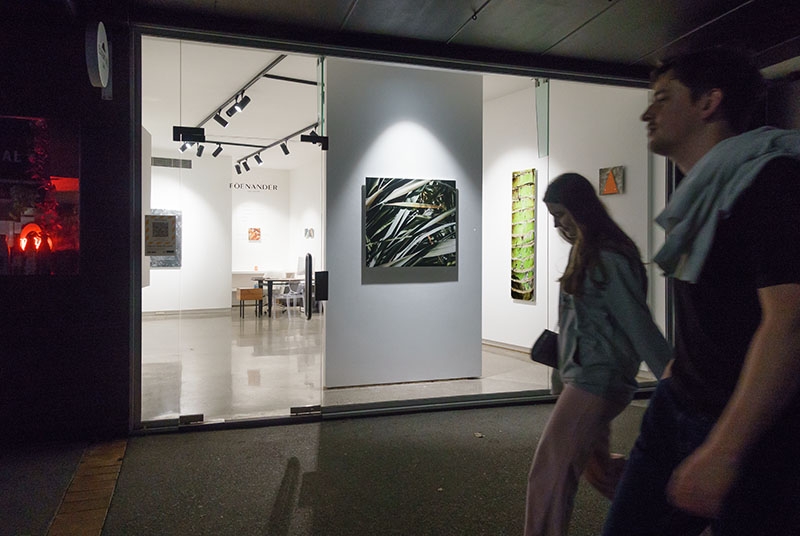
Photos from the opening of Modernist Tendencies exhibition at Föenander Galleries, Parnell featured in ‘Been There’ by Artsdiary
View at artsdiary.co.nz

Photos from the opening of Modernist Tendencies exhibition at Föenander Galleries, Parnell featured in ‘Been There’ by Artsdiary
View at artsdiary.co.nz
By Dina Jezdić
A pale ribbon of lavender cuts across the canvas, slicing through a sea of olive green and into soft charcoal shadow. In Modernist Tendencies, Neal Palmer transforms flax, rendering it as a glowing fragment, pulsing with concentrated intensity. The plant curls inward, folding upon itself in a slow botanical choreography. A single vein deepens and stretches until it becomes a river, winding across the surface with deliberate insistence. A restrained drama plays out in these arrangements.
Each painting frames its subject, speaking in a visual tongue that flirts with abstraction yet remains rooted in the plant’s rhythm and structure. Surfaces catch and release light, while forms shift softly in and out of focus, inviting the viewer into a hush of attention. The works draw from modernism’s language: diagonal lines emerge, planes overlap, and every element is placed with purposeful care. Named simply from Composition I to Composition XVI, the series holds the clear restraint of early twentieth-century abstraction, where formal exactness and sensory richness exist in delicate balance.
Beneath the surface of these works, a language unfolds. Palmer wields the tools of modernism: geometry, repetition, exact lines, but reimagines them as gestures of softness: the gentle play of light upon skin, the hushed stillness of attentive seeing, the gradual gathering of emotion beneath form. Where modernism strips away, Palmer layers and saturates. His close framing pulls the viewer into a near-cinematic intimacy. Shapes blur and textures bloom, flax folds thick and dense, resembling woven sinew or cloth, alive with tactile presence. It is within this tension between order and feeling, between clarity and depth, that the paintings find their voice and begin to speak.
Phormium tenax is no flax in the biological sense but a lily, native to Aotearoa. Its long leaves rise like swords, arranged in fans where the central rito, or new shoot, stands guarded by the parent leaves, a pattern that echoes the bonds of family. For Māori, harakeke is far more than a plant. It holds knowledge, serves as a resource, and carries whakapapa. Used in weaving, healing, and ceremony, it is harvested with care and respect. Palmer does not depict this explicitly, yet it hums through the work in the way he lingers on each leaf, rendering them with a tactile reverence. His work reaches beyond ethnobotany into something devotional, almost ritual. These paintings are warm and bodily, inviting stillness and offering space for meditation. By returning to each canvas as a farmer might to the soil, Palmer sweeps wide brushes through wet pigment, softening sharp edges, breaking lines, and letting the surface breathe.
Perhaps this is a soft rebellion, born in a time marked by ecological uncertainty. Turning toward the more-than-human world becomes an act heavy with meaning, reminding us of our deep and tangled connection to all that surrounds us.
At its heart, Modernist Tendencies draws attention not just to the plant, but to the act of looking itself. It is a practice of sustained attention, of remaining with something long enough for it to shift, and to reveal new dimensions.
Here, harakeke refuses to be reduced to mere specimen. It stands as presence itself, a living, unfolding encounter, one of gentle majesty.
Modernist Tendencies is showing at Föenander Gallery from 1st-20th August 2025.
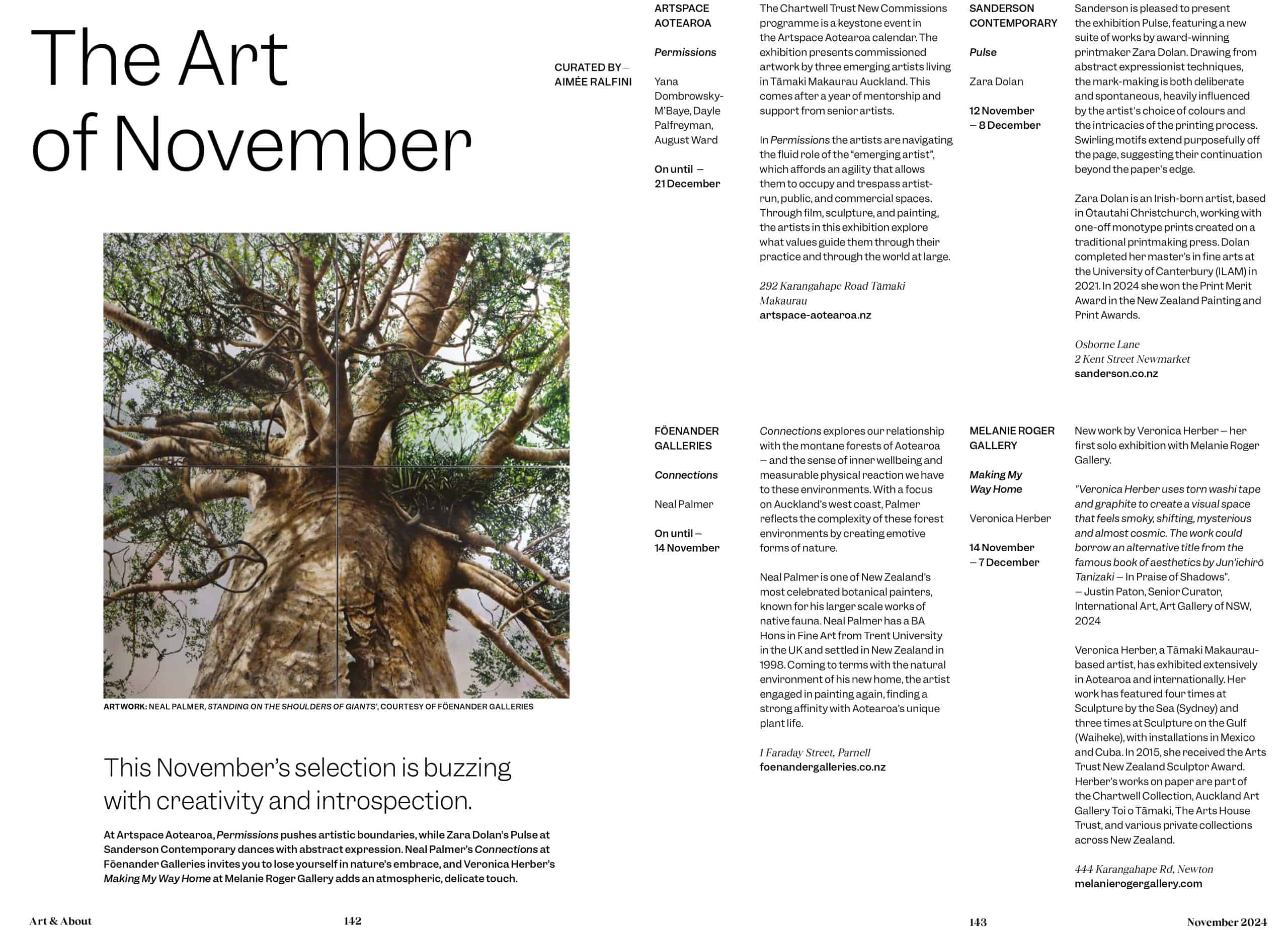
Verve Magazine, November 2024
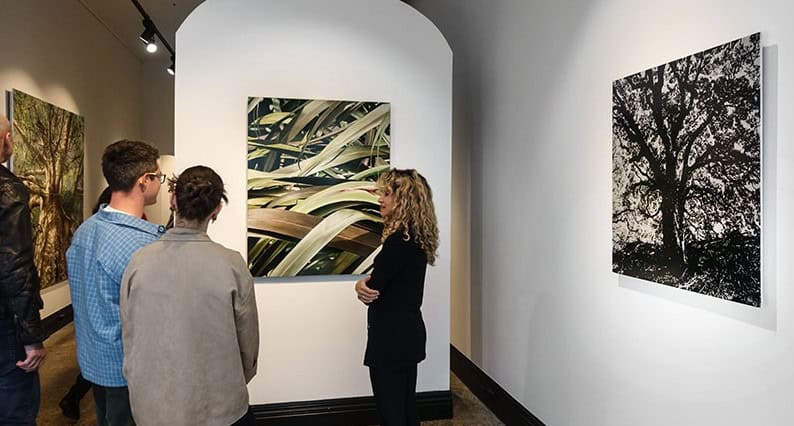
Photos from the opening of Connections exhibition at Föenander Galleries, Parnell featured in ‘Been There’ by Artsdiary
View at artsdiary.co.nz
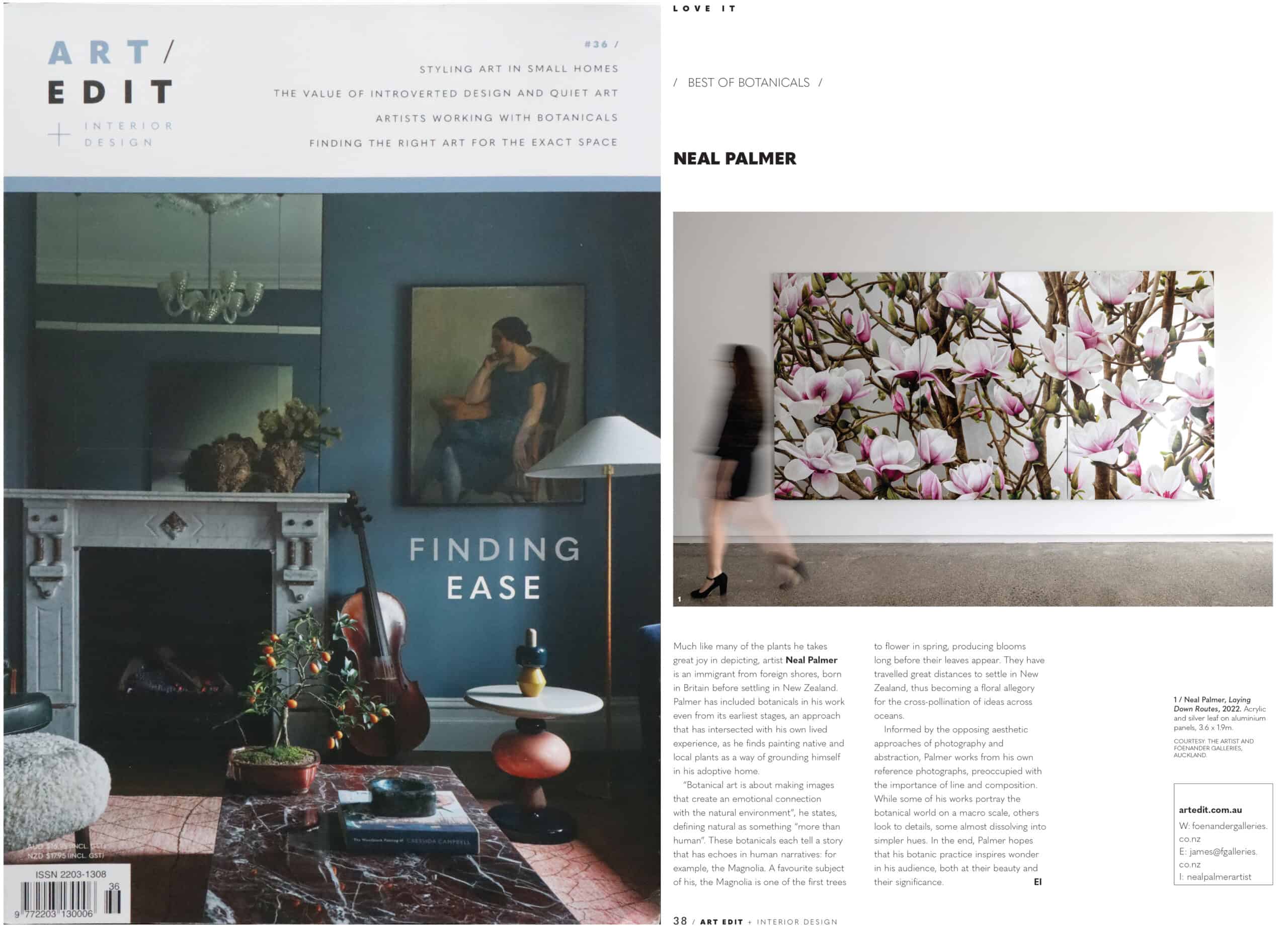
Art Edit #36 (2023), ‘Love It’ – Best of Botanicals, artists whose work focuses on plants.
UK born painter Neal Palmer immigrated to New Zealand in 1998 and has been painting full time ever since.
Visit Creative Matters to read more, view photographs and listen to the podcast interview with Mandy Jakich.
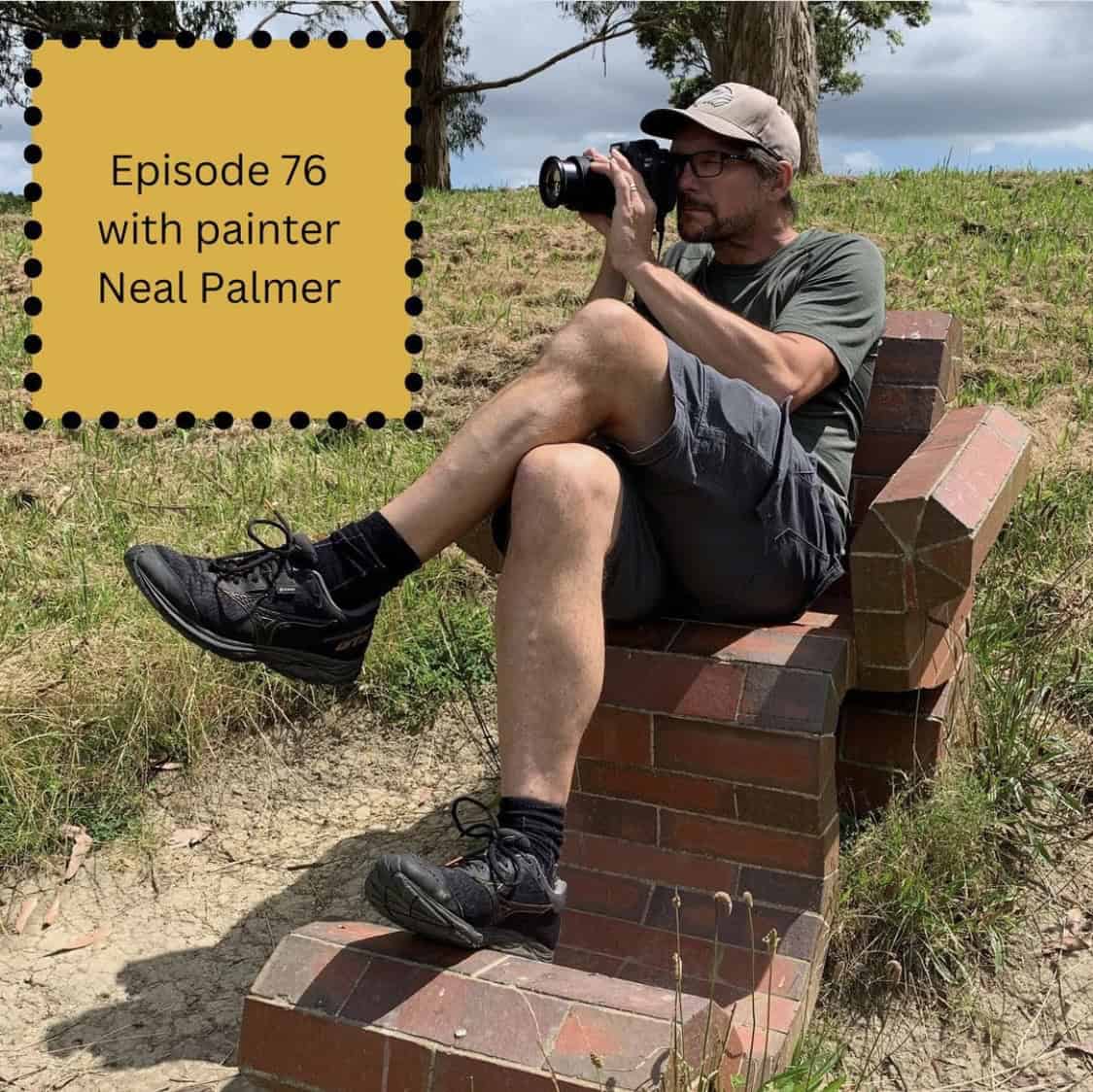
Painter Neal Palmer goes large (Listen 9’41”)
Ahead of starting an artist residency at the Auckland Botanic Gardens, painter Neal Palmer is about to unveil his largest paintings yet – of kauri, flax and magnolias.
It’s part of his 27th solo exhibition called Under the Surface.
Since moving to New Zealand from London more than 20 years ago, Neal has been drawing, painting and photographing native plants and trees.
At first glance, his paintings may look like simply faithful representations of our flora. But he’s asking us to dig deeper, particularly to think about our fragile ecology.
Lynn Freeman took Neal Palmer back to his first impressions of Aotearoa.
Photographic documentation of On Track at Föenander Galleries, November 2021
View on artsdiary.co.nz
Neal Palmer captures the drama of the New Zealand bush and endangered kauri:
On Track, Foenander Gallery, Mt Eden
14 November – 02 December
Reviewed by John Daly-Peoples
In 2018 Neal Palmer was the inaugural artist for the Karekare House residency provided by the Eden Arts Trust.
He has previously exhibited work from this period which he has continued to develop. His latest exhibition “On Track” at Foenander Gallery reflects on those original works which were intended as visual responses to walking and running the Hilary Trail on Auckland’s West Coast. Added to this his awareness of the issue of Kauri dieback has meant these new works have taken on a more urgent significance in response to the disease... Read more:


Valley of history, Artists at Karekare – Art News, Summer 2018
A curiosity for the environment and Greek mythology inspires an Auckland exhibition.

‘From the Outside’
Auckland painter Neal Palmer has strayed into new territory with his latest exhibition ‘Horsing Around’ which features thoroughbreds from the Karaka Sales…
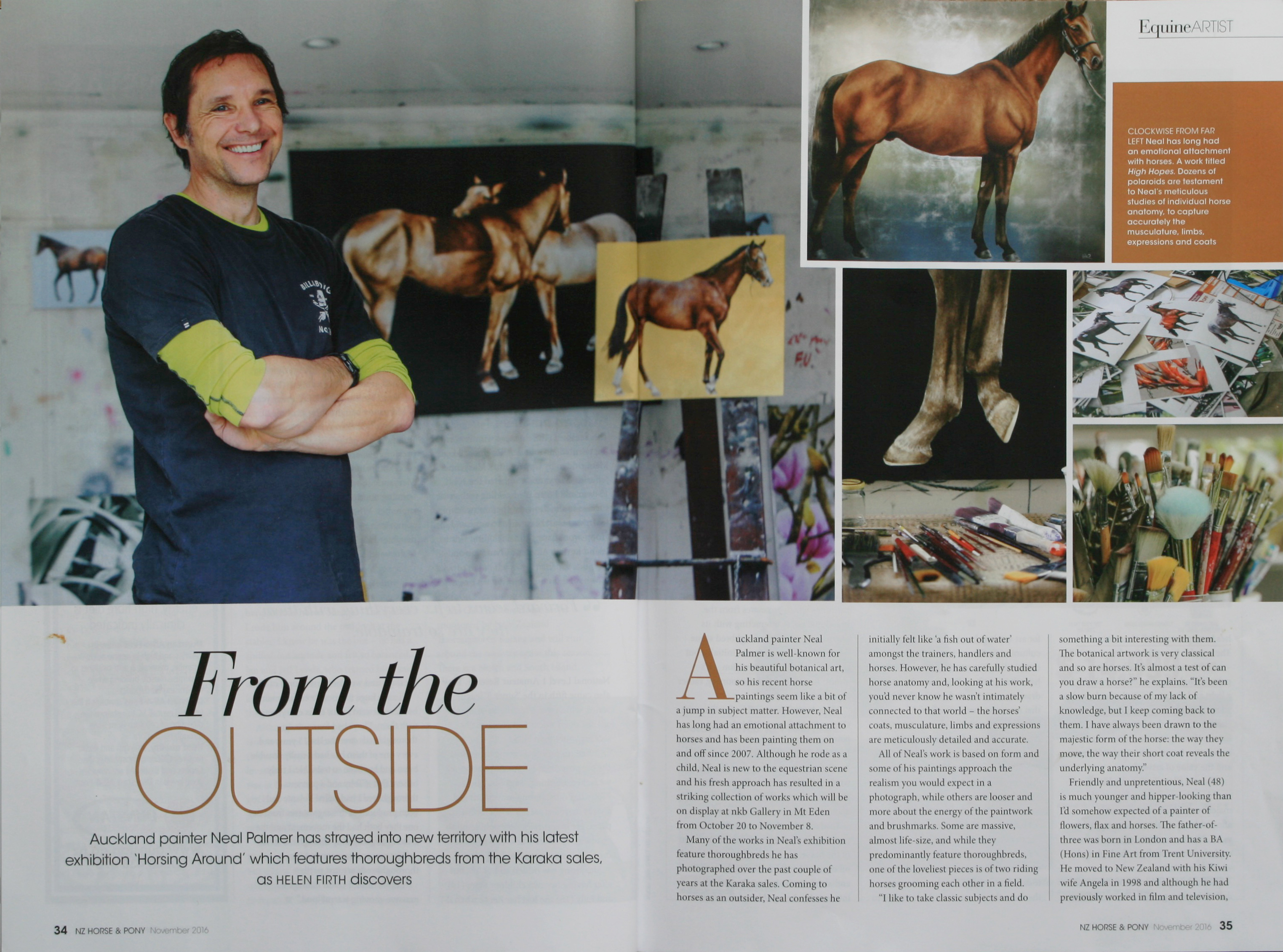

Central Leader, 15th October 2015
Mt Eden painter utilises ancient art technique – read the article here.

Eleanor Black visited the studio for a gilding lesson and promo for my upcoming show – Complex Rhythms at nkb Gallery, Mt Eden (October-November 2015)
Article and video here

New Zealand’s definitive design destination…
Neal Palmer’s quadtych painting Hide and Seek hangs above the dining table.
“The floor was a labour of love for me. It’s based on the squares of the tapa cloth, using the geometric shapes to break up the areas. It took two weeks – I used acrylic and hand to paint a layer a day. The whole family was around at the time but eventually they got kicked out while I varnished it. It’s been down seven years so it’s lasting.
It’s a good home for the three children. It was particularly good when they were toddlers – being open plan you could keep tabs on them but as they got older we put some extra doors in to block off the TV area and give them some privacy.
It’s a mixture of our personalities. My work comes and goes as I paint for shows. In the most recent I was interested in the shapes and forms flax create. The Dick Frizzell tiki in the back is a favourite of my wife Ang’s. The coffee table was her idea. She’d been collecting those teacups – they’re all slightly different colours and slightly transparent.”
Photograph: Patrick Reynolds
Interview: Olivia Tully

“There are red, decaying leaves, the spots of insect attack and edge-eating beetles mixed in with vigorous growth. The skill of the painting is undeniable and very attractive but these read less as symbols of mortality and more as an element of realism.” (T.J. McNamara, nzherald.co.nz)
“The breathtaking large paintings of flora create an amazing scale relationship with the viewer. Despite the size of the paintings Palmer still captures the very essence of the subject he decides to paint, through extraordinary focus on detail.”
– Ponsonby News
“The artist thrusts his plants uncompromisingly at us. Nowhere is this more apparent than in one long painting which is a grove of flax, dense enough to hide in with the growth patterns of its leaves making a syncopated rhythm right across.
As well as the rhythm there is the harsh reality of the ravages of insects on the leaves.” (T.J. McNamara)

Artist Neal Palmer has been known to upset the neighbours. In diligent pursuit of his metier, he takes thousands of photographs of plants and flowers. Patrolling the streets of suburbia he’s apt to blur the boundaries should he spot a likely specimen. “Once I got told off when trying to snap a kowhai, but I try to ask permission if I can,” he explains.
Artist Tony Ogle’s house features a Neal Palmer hibiscus painting.
Ogle has a storage unit full of art, and rotates the works on display to keep them fresh. “I can get a bit complacent about the works.” The Neal Palmer hisbiscus, however, suits the room so well he never moves it.

“The paintings of Neal Palmer, at the SOCA Gallery in Newton until September 27, are also exceptionally large. The subject, when it is vegetation, is enlarged far beyond its natural size. The results are often vivid and the appropriately titled Flame Thrower is a surge of scarlet flowers spread in great detail across three panels. The painting is given weight by the column of the main stalk of the flax flower and the drooping weight of decaying leaves.” (T.J. McNamara)
– New Zealand Herald
“Precision on a grander scale is apparent in the work of Neal Palmer who is showing at SOCA Gallery in France St, Newton. Individual paintings often consist of panels of aluminium on board. They are held together by a dancing rhythm of intersecting geometric arcs. Behind these are accurately painted pohutukawa and flax. These are exuberant, three times life size, and often startlingly red though with a hint of decay and insect activity. The brushwork emphasises such things as the fibrous nature of flax leaves.
The rhetorical enlargement, geometry and realism celebrate the variety of growth in many forms, from the trumpeting stamen of a big red hibiscus in Feeling Fruity, to the erect thrust of red flax flowers in Big Love.
This accomplished exhibition is called The Sum of Their Parts and surely the total comes to more than their sum.”
Suzie Campbell Snapshot Reality: The Painted World of Neal Palmer

“Making puppets for the famous 90s TV show Spitting Image is about as far as its possible to get from the iconic New Zealand paintings Neal Palmer creates today.” (Estelle Sarney)

